Architectural visualization has always been an integral part of architecture. Clients must understand what a project is about before its construction through concepts, renders, visuals, animations, and project showcases. In the current competitive market, architecture companies must deliver digital experiences to show off their knowledge and skills. Here, Converge AI enters our discussion as one of the companies that can change the industry. Instead of utilizing fragmented solutions that focus on design, content production, story-making, and website development, Converge AI focuses on AI-driven ecosystem solutions.
In the case of architecture companies, it implies delivering an interactive digital experience from static portfolios and making it easier to create marketing materials, presentations, websites, and client-oriented platforms. Solutions like Framia Pro and Enter Pro are the main driving forces behind such a transition.
Portfolio as an immersive experience
Ten years ago, an architecture portfolio could be a simple document including several images of previous works of an architect or a company. Nowadays, clients expect much more.
Before getting in touch with a firm, potential clients usually check out the following:
- Gallery of previous projects
- Visualizations of designs
- Walkthroughs
- Social Media content
- Firms’ websites
- Presentations
- Showcase of past projects
This has led to architecture firms acting more like visual storytellers and not service providers.
The problem lies in the fact that creating all these assets requires different tools and different people as well as time-consuming workflows.
AI-native solutions are disrupting the traditional workflow models.
How Framia transforms the future of architectural storytelling
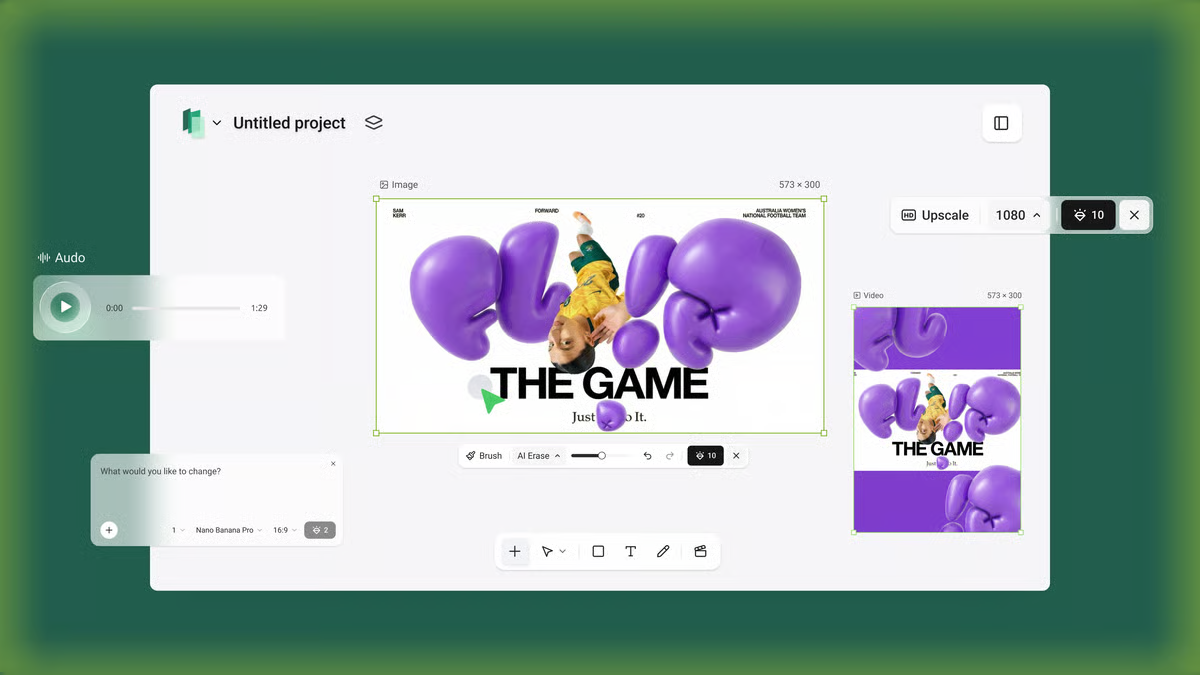
Among many advantages of Framia, the one worth highlighting is the platform’s role as a multimodal creative operating system that allows combining multiple processes such as image generation, video creation, design editing, and creative direction into one connected experience.
Architecture firms can leverage the platform to create their own professional portfolio with consistent visuals across all channels.
Turning creative ideas into presentation-ready assets
It’s typical for an architectural project to undergo several iterations before becoming complete due to numerous changes clients ask for.
Conversational editing and asset generation capabilities provided by Intelligent Canvas can significantly ease these workflows for architecture firms.
With the help of Framia, teams can do the following:
- Generate architectural visuals
- Develop presentations
- Edit creative assets using conversations
- Modify the layout using natural language commands
- Produce additional visual content
In place of switching back and forth between different design tools, architects can operate in a single creative space, where iterations will take place organically.
Design Agent is useful for maintaining professional branding
Architecture companies depend greatly on high-quality visual communication.
The Design Agent of Framia Pro provides options for:
- Portfolio design
- Presentations of projects
- Graphics for social media channels
- Visual content for marketing campaigns
- Visuals that incorporate a brand identity
- Proposals
Thus, architecture firms may keep their brand identity consistent across various types of communications with clients, websites, and promotional campaigns.
Another unique feature is editing of generated designs. Instead of getting immutable outputs, the user may tweak individual elements, arrange parts differently, change texts, and create alternative layouts without starting a project from scratch again.
From architectural renderings to project narrative videos
It is not enough just to show beautiful buildings.
Clients need to know:
- What the spaces feel like
- How the users interact with spaces
- How a project accommodates their lifestyle
- How it integrates into their community
While static graphics do help in achieving the above, video storytelling may bring better results in terms of emotion.
Video agents designed specifically for advanced visual communications
In Framia, video agents are created specifically to assist architects in creating visual stories about projects.
The Video Agent allows you to create videos about:
- Architectural designs
- Marketing
- Animation videos
- Social media videos
- Brand video stories
Instead of creating simple videos, here we speak of workflows that are focused on creating visual harmony in stories.
Selecting the proper way to tell your story
Every architectural project requires a different way to communicate its message to the audience.
For instance, if you want to create a video for social media purposes, the Shorts Agent will be an excellent choice.
Use it for:
- Instagram videos
- Fast presentation of projects
- Social media marketing campaigns
- Construction updates
If you are planning to tell a bigger story using a longer video format, consider the Movie Agent that provides options for:
- Presentations of projects
- Emotive videos
- Client communication
- Telling stories
Portfolio creation without further generation
While many AI applications are primarily focused on generation, architecture projects demand iterations.
These editing capabilities are provided via Framia by means of:
- Layered designs
- AI-generated changes
- Contextual edits
- Storyboard operations
The Storyboard Editor is an example of an integrated feature that helps combine editing and generation.
Framia allows for:
- Arranging clips
- Re-generating particular frames
- Audio synchronization
- Sequence optimization
- Working with AI agents
Such functionality greatly decreases the necessity for using third-party editing tools.
Beyond portfolios: clients require seamless digital solutions
While creating stunning visuals may be one side of growing your architecture firm, there is more to it than that.
Clients expect to receive from you:
- Interactive websites
- Inquiry systems
- Booking consultations
- Digital presentations
- Portals
- Project management interfaces
That’s why switching from Framia Pro to Enter Pro is so important.
Whereas Framia was focused on creative generation, Enter builds on top of it and provides additional capabilities related to development, automation, and building web interfaces.
Enter AI and future architecture firm websites
Enter acts as an AI-native development ecosystem that allows for simple application and website development processes.
No longer do you have to fully depend on developer teams; with Enter, you can generate:
- Portfolio websites
- Client portals
- Appointment system
- Project dashboards
- Interactive presentations
- Lead generation platforms
Using natural language conversations.
Website building with AI assistance without code barriers
One of the main strengths of Enter is the capacity to take ideas and turn them into applications.
The ecosystem at Enter includes:
- AI Website Builder
- AI App Builder
- Visual Editor
- AI Agent Builder
- Collaborative coding
Thanks to such ecosystem, companies can speed up their idea deployment.
For small studios, it can make a great difference, as they do not have dedicated specialists.
Importance of the Visual Editor for architects
As the name suggests, architecture involves many visual details that need to be taken into account.
Using the Visual Editor at Enter AI, users can directly edit all sorts of interface objects, layouts, and other structural components.
Instead of only using prompts, teams can achieve better control over the appearance and functionality of digital projects.
Use case scenarios – who benefits from AI-based workflows
Several parties in the architecture sector can enjoy the potential of such platforms as Framia and Enter.
Boutique architectural studios
Such firms may lack marketing and development units, while unified AI workflows will make them competitive against bigger rivals.
Interior design companies
The importance of visual storytelling and client presentations means that the value of multimodal creative systems in interior design cannot be overstated.
Firms involved in real estate and development
The processes of project marketing, investor presentations, and creating digital showcases will greatly benefit from the ease of content production and website creation.
Large architecture firms
Companies with enterprise-level teams will be able to utilize AI-native software to increase collaboration and consistency in production.
The future of architecture marketing is inter-connected
Firms specializing in architecture have entered an era in which digital infrastructure and creativity go hand in hand.
Firms can leverage multi-modal creative workflows, creative assistance from AI technology, agents and conversational editing offered by Framia AI. The product known as Enter AI helps firms create websites and applications using AI-based tools.
Combined, the two products offer firms access to interconnected workflows and platforms for portfolio creation, marketing, client presentations, and more.
Given the increasing need for architecture firms to compete in an increasingly digital environment, such inter-connected workflows may very well become essential.